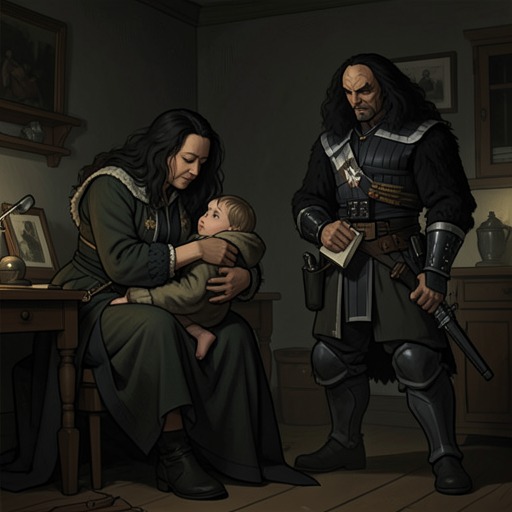
What any good father would do
The Changeling“What any good father would do” is a recurring moral claim about fatherhood, not a reliable verdict on a father’s actions. In the novel, providing for a family, protecting a child, and sacrificing for loved ones are all presented as duties, but the phrase also exposes how easily those duties can be used to excuse neglect or violence. Its meaning shifts between William Wheeler’s remorse, Jorgen Knudsen’s defense of an inherited bargain, and Apollo Kagwa’s own answer to the question of what he would do for his child.
Fatherhood Beyond Provision
William Wheeler’s account establishes the domestic problem against which the expression resonates. He tells Apollo Kagwa that he belongs to a generation of men who assumed that working and providing made them good fathers. After twenty or twenty-five years, he says, a man might find that his wife did not know him and that his children might respect him without sharing happiness or closeness with him. William’s regret is not that he failed to work, but that he mistook work for the whole of fatherhood.
He contrasts his expectations with the demands facing younger parents, who may both have to work to remain financially secure. The change is not simply generational: the old ideal of a man supporting a family on one income no longer seems available to everyone. William sees fathers pushing strollers on the way to work or spending early mornings at the park and realizes that he missed the intimacy of ordinary childcare. He says his own father never taught him to value that part of family life, and that the old arrangement did not even make him rich; he worked hard merely to stay afloat.
His regret becomes personal when he admits that he loves his daughters but never said so, believing that his efforts made his feelings obvious. He recognizes too late that love had to be spoken. William says he is spending most of his savings trying to win Gretta Wheeler back, and hopes that the book he has bought might show her he is serious. Gretta had read the story to their daughters as her own father had read it to her; William once called his wife Mockingbird, but cannot remember when he stopped. He says they became strangers despite his never hitting or cheating on her and their barely arguing. His story makes care and provision real but insufficient: the outward performance of responsibility did not ensure that his family felt loved.
The Question Jorgen Poses
Jorgen Knudsen turns the question of fatherly duty into an explicit challenge to Apollo. Having acknowledged his guilt for what he and the men in his family have done, Jorgen taps the scar on his throat, evidence of an earlier suicide attempt, and asks, “what would you do for your child?” Apollo answers, “I’d do anything,” and Jorgen insists that this is what a good father must say and do. The exchange makes the claim sound universal: a parent’s devotion is measured by an unlimited readiness to act.
But Jorgen’s own family history reveals the danger hidden inside that apparent certainty. He describes his son’s resentment at inheriting the Knudsen house and its debts, and at the loss of what the son believed had once been white men’s birthright in America. The son came to regard the troll not as a burden but as a blessing and believed the family should return to its traditions. In Jorgen’s account, he repeated the pact made by Nils Knudsen one hundred and ninety years earlier. Jorgen says he admired his son’s fortitude, even though the family’s return to the pact meant renewing the sacrifice of children.
The inheritance at issue is therefore more than a house or debt. Jorgen’s explanation binds economic grievance, family tradition, and the claim to protect one’s own into a justification for repeating an old violence. The language of paternal duty does not by itself distinguish care from harm; its moral value depends on what a father does and whom his actions endanger.
Protection, Deception, and Violence
Jorgen’s final revelation makes that ambiguity immediate. He tells Apollo that the open front door and porch light are a signal for his son to run. What Apollo had taken for a confession was also Jorgen’s attempt to give his son time to escape. Jorgen presents this as the last thing he can do as a father, then asks Apollo to give him the blade. Apollo instead brings it to Jorgen’s neck and kills him. The protective gesture is real, but it does not erase Jorgen’s participation in the family’s history of sacrifice or the violence surrounding the pact.
The expression returns in Apollo’s exchange with Kinder Garten. Apollo tells him that Jorgen tried to protect him. Kinder Garten replies that being raised by a man like Jorgen was worse than being abandoned. Apollo answers, “He did what any good father would do.” Kinder Garten immediately disputes the standard: a good father should protect his children, he argues, but Jorgen’s failure to save money or plan for the future left him with what he calls no choice but to make a great sacrifice. The argument is not a simple opposition between a loving father and an ungrateful son. Both men make protection central to fatherhood, yet they judge the father by different consequences: Jorgen’s attempt to preserve his son’s life, and the damage Kinder Garten associates with being raised by him.
A Phrase That Cannot Excuse the Act
The expression’s repetition gives it force while preventing it from settling into a comforting rule. Jorgen uses Apollo’s willingness to do anything as evidence that they share a father’s obligation; Apollo later uses the same moral language to describe Jorgen’s attempt to protect his son. Kinder Garten turns the claim back against both of them, insisting that protection also means planning for a child’s future and refusing to make that child bear the cost of a parent’s choices. Each speaker appeals to paternal responsibility, but the appeal does not resolve their conflict.
The surrounding plot sharpens that instability. Apollo encounters a cruel post on the “Tribute to Baby Brian” Facebook page from an account using the name Kinder Garten, including a meal joke about Baby Brian. Elsewhere, Jorgen explains that in the past he searched for unprotected children but that, with an internet connection, a man can now find them without leaving home. These details place claims about protecting children alongside the means by which children can be found and threatened. The phrase therefore works as both a declaration of love and a test of the actions that declaration is asked to cover. William’s failure is to believe that provision alone makes love evident; Jorgen’s is to place inherited violence inside the language of protection. Against both, the novel leaves the words “good father” unresolved until the consequences for the child are faced.